

Pillow height science
History
Ancient pillows were often made from wood or ceramic, surviving examples range from as low as 6 cm to over 15 cm in height (1). By the late Ming dynasty, writers were linking pillow firmness and height to neck health. In his 1591 manual: Eight Treatises on the Nurturing of Life, Gao Lian argued that firm, elevated pillows prevented the “slumping” that leads to stiffness and helped keep the neck straight into old age (2).
In Japan, some wooden makura (pillows) incorporated simple adjustment mechanisms — slotted bars, pins, or stacked components — allowing sleepers to fine‑tune height to within half an inch (3). Today in Japan, rolled towels are commonly used under the pillow to personalise loft (4).

Old ceramic pillows vary in height from 6 cm to 15 cm.
Why Pillow height matters
A survey of 800 people found around one third sometimes woke with neck or shoulder pain (5). Physios, osteopaths and chiropractors find that “pillow height does have a significant impact on neck pain and symptoms” (6,7).
In 2016, research using pressure mapping and modelling to investigate what is happening in the neck found “Pillow height elevation significantly increased the average and peak pressures of the cranial and cervical regions, and increased the extension and lordosis of the cervical spine. The cranio-cervical pressures and cervical spine alignment were height-specific, and they were believed to reflect quality of sleep (8).”
In their 2021 review of pillow studies, Lei and Yang state “The ideal pillow height should help maintain the physiological curvature of the cervical spine by providing appropriate support to the head and neck” (9).
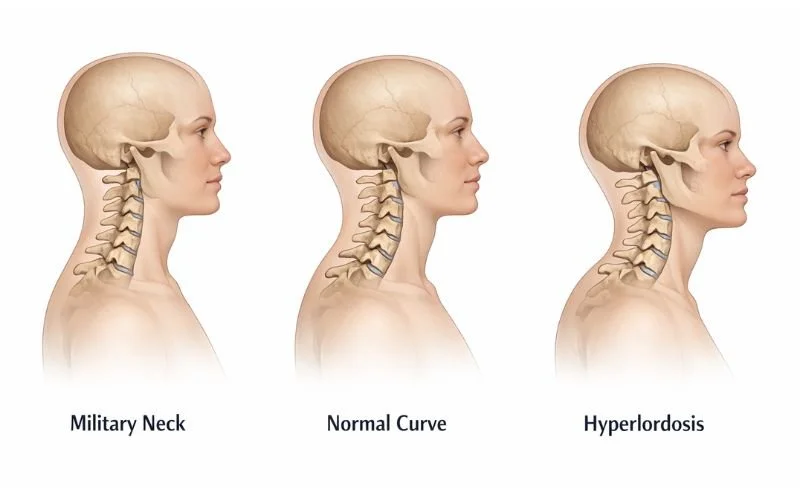
There is individual variation in cervical curvature. “Ideal pillow height should maintain the physiological curvature of the spine” - Lei and Wang, 2012
Pillow height and sleeping position
Research indicates that suitable pillow height is different for different sleeping positions. After their broad-ranging review of pillow studies Lei and Yang give this perspective: “Pillows with a uniform height, which are common in the market, are not suitable for both lateral and supine positions during sleep” (9).
In 2016 Cai and Chen found standard pillows were consistently too high for the supine (back) position and too low for the lateral (side) position (10). They went on to suggest the following, very different heights: 2.5 to 4 cm for supine use, 11.5 – 15 cm for lateral use. Note, there is not just a difference between the positions, there is variation required within one position; this is due to considerable anthropometric variation.
Changing position whilst asleep is common. A large study found an average of 1.6 position shifts per hour (11). Some individuals sleep in both lateral and supine positions, pillows offering a choice of two heights have been on the market for over a century (see US patent diagram).
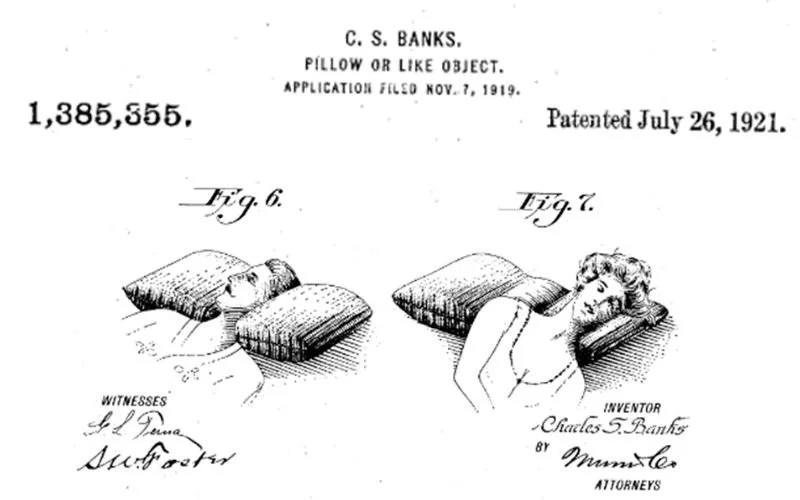
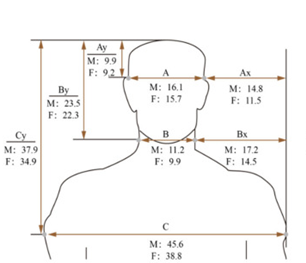
Diagram showing average anatomical variation between Taiwanese males and females in Cai and Chen’s pillow study. These are averages, so the actual variation of individuals would be considerably greater. (10)
What is optimal pillow height?
Research has investigated what height is optimal for lateral sleeping. Sacco (12) used 5 cm, 10 cm and 14 cm pillow heights with 21 participants, the 10 cm height was most comfortable while the low (5 cm) triggered most muscle activity.
Jiao et al (13) related pillow height to shoulder width, this study found that matching pillow height to shoulder width reduced muscle activity and was the most comfortable.
A 2024 study: “The individualised optimal pillow height and neck support for side sleepers” found that a medium height (compared to shoulder width) was best at reducing internal force on vertebrae, and this position aligned the spine, neck and head in a way that was similar to the alignment when standing. However, subjects preferred around 2 cm more loft. In this study it was speculated that participants’ regular pillows had habituated them into this preference (14).
It should be noted that mattress firmness changes the effective pillow height for side sleepers, generally a softer mattress reduces the required pillow height (Ren et al 8).
For supine sleeping, it is suggested that pillows which support normal lordosis (see diagram) allows cervical discs to be under even pressure and muscles to relax (Ren et al, 8).
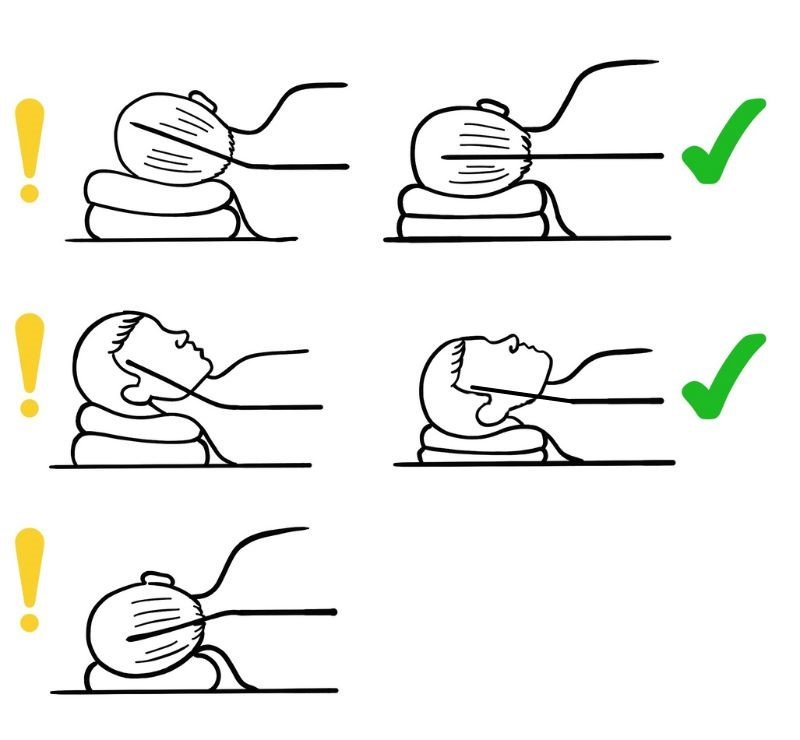
For side sleeping, a pillow height linked to shoulder width is found to be optimal for most sleepers (Jiao 2024). Whilst for back sleeping, a height which supports the users natural cervical alignment is suggested (Ren 2016).
The benefits of personalising pillow height
Leading clinicians in this field - Shuori Yamada and her father - have assessed more than 120,000 patients and developed a structured method for clinically adjusting pillow height (15). In 2023, Yamada reported outcomes from 84 adults who visited a hospital with neck or shoulder complaints. After their pillow heights were individually optimised, around half experienced significant improvement in symptoms (16).
Analysis of muscle activity in side sleepers shows that matching pillow height to shoulder width results in the least muscle tension (Jiao 12). Similar results were found by Tian et al (13).
Adjustable Pillows
While adjustable pillows are available, many are of the “adjustable fill” type which have a drawback: height and firmness are inherently linked. Adding more fill increases both the loft and the density of the pillow, making it firmer. Removing fill lowers the height but also reduces support. This coupling makes it difficult to optimise height without simultaneously changing how the pillow feels and supports the head and neck.
Furthermore, the loose fill in an adjustable pillow may move, causing uneven support.
Current Pillow use
Most people use two or more pillows. A 2022 YouGov survey of over 2000 people found 58% slept with 2 or more pillows (17). Whilst some will be using extra pillows to support various body parts, many are stacking pillows in a rudimentary way of adjusting their pillow height.
Summary
When it comes to pillows, the evidence suggests there is no one‑size‑fits‑all height. Body shape, sleeping position, and mattress firmness all change the support a person needs, yet most pillows offer only a single loft. Many people shift position during the night, so the optimal height can vary even for the same sleeper. Across biomechanical studies and clinical work, a solution emerges — when pillow height is individually adjusted, muscle activity falls, pressure on the neck decreases, alignment improves, and many people experience meaningful symptom relief. Standard pillows may not achieve this match, which may be why so many sleepers resort to stacking pillows. Personalised pillow height is a practical, evidence‑supported approach to help more sleepers achieve a comfortable position through the night.
References:
1) A Tang‑dynasty ceramic pillow in the Henan Museum measures just 6 cm in height, making it one of the lowest verified examples in a major collection. A Northern Song ceramic pillow in the Freer Gallery of Art (Smithsonian) has a documented height of 10 cm, confirming mid‑range examples. A Yuan‑dynasty Cizhou‑ware pillow in the Victoria & Albert Museum stands 15.2 cm high, demonstrating that some ancient ceramic pillows exceeded 15 cm.
2) Gao Lian. Eight Treatises on the Nurturing of Life. Translated by Shih‑Shan Susan Huang (various excerpts available in secondary scholarship). Originally published 1591. In this work he specifically discusses the benefits of different pillow materials. He notes that firm pillows help "rectify the bones" and prevent the "slumping" that leads to stiffness.
3) The Horniman Museum holds a Japanese wooden makura with slotted bars and a pin mechanism that allowed the user to adjust its height. Some examples allowed adjustment in increments of half a sun – about 1.5 cm.
4) Nihon Minzoku Daijiten [Encyclopedia of Japanese Folklore], Heibonsha, entry “Makura ” noting that pillow height was commonly adjusted using rolled cloths or towels.
5) Susan J. Gordon, Karen A. Grimmer‑Somers, and Patricia H. Trott, “Pillow Use: The Behavior of Cervical Stiffness, Headache and Scapular/Arm Pain,” Journal of Pain Research 3 (2010): 137–145.
6) Physiotherapy Matters, “Neck Pain and Sleeping Position,” April 22, 2025, https://www.physiotherapymatters.co.uk/blog/neck-pain-and-sleeping-position/
7) The Waterside Practice “Choosing the Right Pillow for a Healthy Neck: An Osteopath’s Perspective. Active Health Chiropractic (Cosham), Sleep Posture Tips. https://www.activehealthchiropractic.co.uk/sleep-posture/
8) Sicong Ren, Duo Wai‑Chi Wong, Hui Yang, Yan Zhou, Jin Lin, and Ming Zhang, “Effect of Pillow Height on the Biomechanics of the Head‑Neck Complex: Investigation of the Cranio‑Cervical Pressure and Cervical Spine Alignment,” PeerJ 4 (2016): e2397.
9) Lei, Zhen, and Zheng Wang. “Effect of Different Pillow Heights on the Biomechanics of the Cervical Spine: A Finite Element Analysis.” Chinese Journal of Rehabilitation Medicine 27, no. 6 (2012): 518–522.
10) D. Cai and H.-L. Chen, “Ergonomic Approach for Pillow Concept Design,” Applied Ergonomics 52 (2016): 142–150, https://doi.org/10.1016/j.apergo.2015.07.004.
11) Schjelderup, Skarpsno, Mork, Nilsen and Holterman. “Sleep positions and noctornal body movements based on free-living accelerometer recordings: association with demographics, lifestyle, and insomnia symptoms.” Nature and Science of Sleep 2017:9 267-275
12) Isabel Sacco, Ana M. Aliberti, Ana P. Queiroz, and Fábio M. João, “The Effect of Pillow Height on Muscle Activity of the Neck and Mid‑Upper Back,” Journal of Manipulative and Physiological Therapeutics 38, no. 6 (2015): 394–402
13) Jiao, Y., Zhang, X., Li, Y., and Wang, H. “Effect of Pillow Height on Cervical Spine Alignment and Tissue Loading: A Finite Element Study.” Frontiers in Bioengineering and Biotechnology 12 (2024)
14) Shan Tian, Chenghong Yao, Yawei Wang, Xuepeng Cao, Yike Sun, Lizhen Wang, and Yubo Fan, “The Individualized Optimal Pillow Height and Neck Support Design for Side Sleepers,” Medical & Biological Engineering & Computing, published 16 October 2024, pp. 535–544.
15) Yamada, S. (2023). Orthopaedic Pillow: Theory and Practice. Springer. In this book it states that since 1972, the author and her father have examined more than 120,000 patients.
16) Shuori Yamada, Tohru Hoshi, Michio Toda, Takahiro Tsuge, Ko Matsudaira, and Hiroyuki Oka, “Changes in Neck Pain and Somatic Symptoms Before and After the Adjustment of the Pillow Height,” Journal of Physical Therapy Science 35, no. 2 (2023): 106–113
17) YouGov (2022) “The YouGov Sleep Study: Part two - sleep habits”. Available online at yougov.com/en-gb/articles42963